


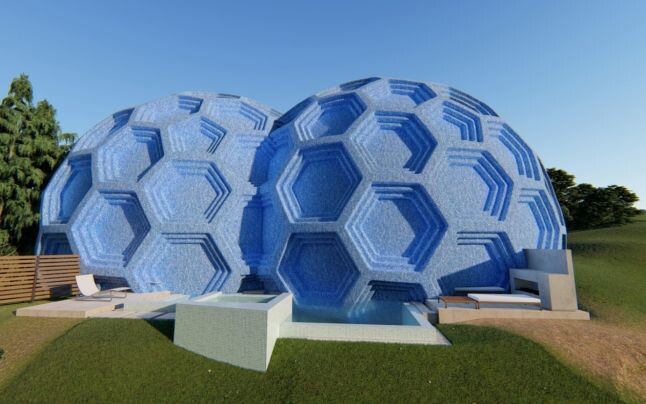
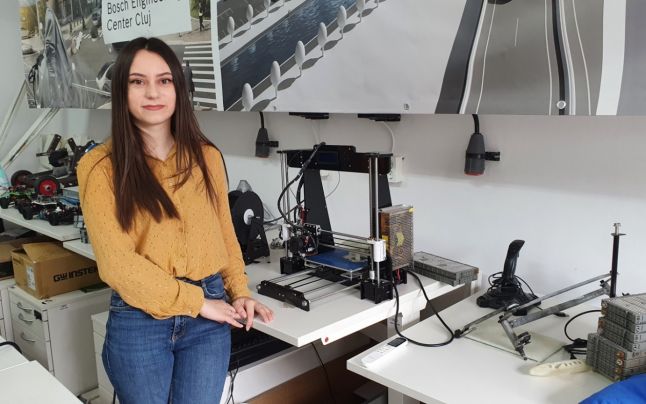
Continuing the series on innovative materials, we present a composite material made from clay and a polymer currently used to increase the strength of concrete, which can be printed with a 3D printer. This innovation was developed by Alina Pepene, a fourth-year student at the Faculty of Engineering at "Dunărea de Jos" University of Galați, along with her colleagues at the Student Scientific Circle of Applied Computer Science in Materials Engineering.
 |
The composite is strong and extremely flexible, enabling the materials needed to construct a house to be printed in just a few days. In its natural state, clay has the disadvantage of being permeable when in contact with water, and it can easily deteriorate during freeze-thaw cycles. However, the new composite material addresses this issue by incorporating a polymer that allows the composite to be used in construction for fluid forms that are more aligned with nature, unlike conventional structures where walls are typically straight. |
Its applications are diverse, including atypical arches and vaults that require special flexibility while also providing impressive strength, similar to that of a honeycomb. Additionally, the advantages of using this material include a rapid printing and assembly speed of just a few days, its ecological nature, and the fact that clay is readily available in nature. Moreover, the concept could potentially be adapted for building habitats on other planets in the future, as the cost of transporting materials from Earth would be too high compared to using the adapted composite and printing techniques.
The composite material performed very well in tests for resistance to low temperatures and degradation over time. The intention is to use it in larger projects, such as constructing apartment blocks, which presents the main challenge at the moment: developing a 3D printer capable of printing the composite material for such projects.
A unique aspect of the concept is its incorporation of bionics, inspired by biological systems created by nature, such as heat exchange and wall ventilation mechanisms observed in ants and termites.