


Amid increasing public pressure regarding the plastic pollution crisis and the harmful impact of micropollutants on human health and the environment, conventional wastewater treatment methods based on activated carbon and ozonation have become less viable due to high operational costs.
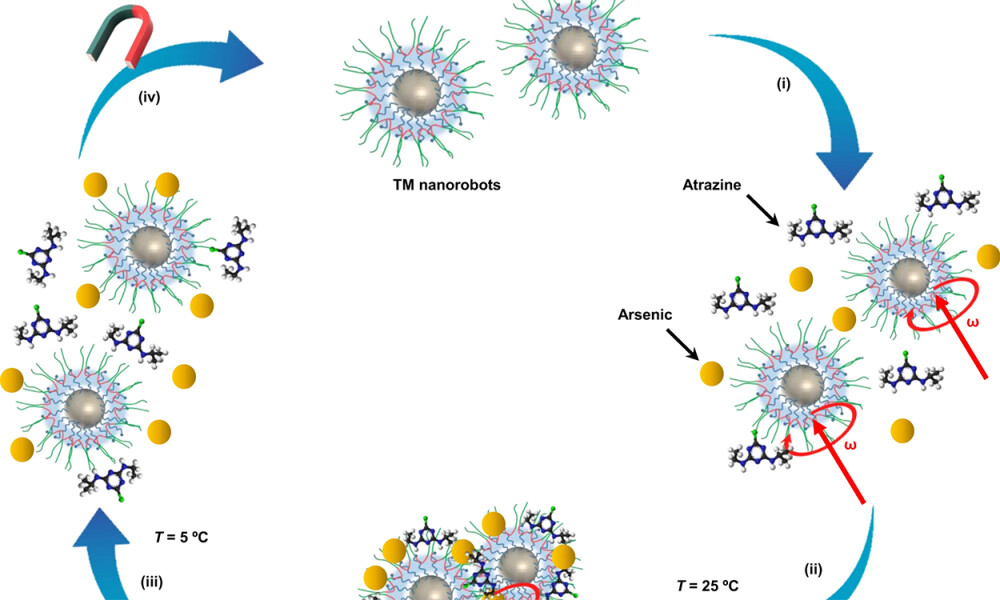
A sustainable and accessible method for cleaning contaminated water from wastewater treatment plants has been proposed by a team of researchers from the University of Chemistry and Technology in Prague. They have created magnetically guided nanorobots capable of capturing pollutants in water using magnetite nanoparticles coated with a temperature-sensitive triblock copolymer (PTBC) and iron oxide. The polymer acts like tiny hands that can collect and remove pollutants from water, while the iron oxide makes the nanorobots magnetic. The researchers also added oxygen and hydrogen atoms to the iron oxide, allowing it to attach to target pollutants. When the temperature rises above 25°C, the dehydration of PTBC and stronger interactions between the polymer blocks trap pollutants in the PTBC matrix, which can then be removed from the water using a magnet and cooled to about 5°C to eliminate the pollutants.
When tested on water containing 5 milligrams of arsenic per liter, the nanorobots successfully removed up to 65.2% of the arsenic in 100 minutes.
The robots are about 200 nanometers wide and are powered by magnetic fields, enabling the team to control their movements.
Unlike other nanorobots that have been developed, these do not require fuel to operate and can be reused, making them sustainable and cost-effective.
"You can change the design or develop [the nanorobots] to target specific chemical particles," says Martin Pumera, an inorganic chemist who led the research, expressing hope that this technology can be scaled up for water treatment.
"This is an interesting piece of work where the capabilities of stimulus-sensitive materials are integrated to create microrobotic devices for the uptake and removal of various types of pollutants," says Salvador Pané i Vidal from ETH Zurich in Switzerland. "One of the future challenges is to create magnetic navigation systems that could translate this technology into cleaning industrial wastewater."
For more information, you can refer to the articles on New Scientist & Nature.